


by Planeta · Espasa Calpe · tapa blanda · ISBN 9788423992522

VAT included



Hamelyn quality guarantee · checked and verified, or your money back
«Diccionario Espasa Pocket» is the Spanish-English bilingual dictionary from Planeta, published by Espasa Calpe in paperback (852 pages, in Spanish and English).
Bilingual reference work with Spanish-English and English-Spanish directions, conceived as a special edition for students. It brings together common terms and expressions in both languages and serves as a practical tool for translating, expanding vocabulary and resolving quick doubts in learning contexts.
The 1999 edition, with ISBN 9788423992522, was produced by the lexicographic team of Nuria Valverde and Jeremy Rogers.
Suitable for students of Spanish and English who need to consult vocabulary quickly and take the dictionary to class or on trips.
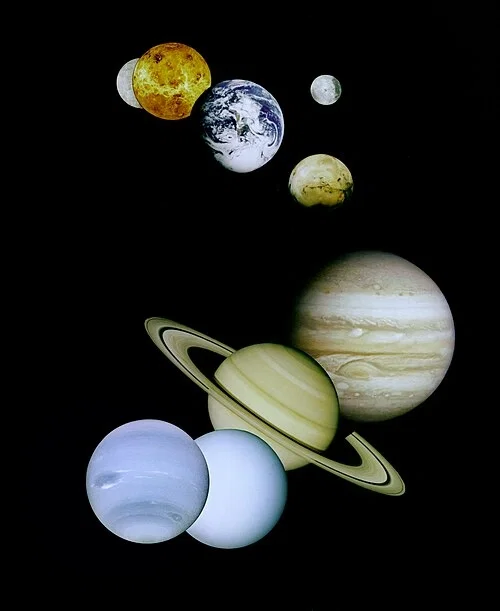
A planet is a large, rounded astronomical body that is generally required to be in orbit around a star, stellar remnant, or brown dwarf, and is not one itself. The Solar System has eight planets by the most restrictive definition of the term: the terrestrial planets Mercury, Venus, Earth, and Mars, and the giant planets Jupiter, Saturn, Uranus, and Neptune. The best available theory of planet formation is the nebular hypothesis, which posits that an interstellar cloud collapses out of a nebula to create a young protostar orbited by a protoplanetary disk. Planets grow in this disk by the gradual accumulation of material driven by gravity, a process called accretion.


