


by PLANETA (EDITORIAL) · Planeta · tapa dura · ISBN 9788475513546

VAT included




Hamelyn quality guarantee · checked and verified, or your money back
«Historia de la Música Clásica. Vol. III. La Era Clásica» is the collective essay by Planeta published in 1983 in hardcover, 173 pages, in Spanish.
Third volume of the series «Historia de la Música Clásica», dedicated to the classical period. It offers a detailed view of the music of the era and its evolution, with a popularizing approach and illustrations that enrich the journey.
Volume III of the collection «Historia de la Música Clásica», published in Barcelona in 1983. The edition features a leather cover with gilt.
Intended for music students, enthusiasts, and readers interested in the evolution of classical music.


Tapa blanda


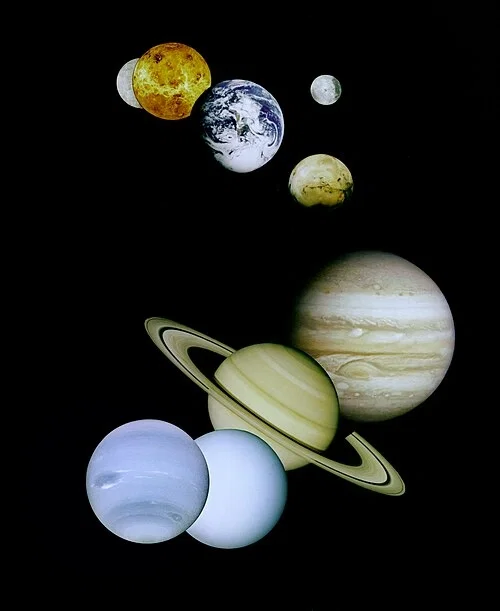
A planet is a large, rounded astronomical body that is generally required to be in orbit around a star, stellar remnant, or brown dwarf, and is not one itself. The Solar System has eight planets by the most restrictive definition of the term: the terrestrial planets Mercury, Venus, Earth, and Mars, and the giant planets Jupiter, Saturn, Uranus, and Neptune. The best available theory of planet formation is the nebular hypothesis, which posits that an interstellar cloud collapses out of a nebula to create a young protostar orbited by a protoplanetary disk. Planets grow in this disk by the gradual accumulation of material driven by gravity, a process called accretion.


