Buy 3, pay for 2 — use code TRIPLEUS at checkout.


by PLANETA (EDITORIAL) · Planeta · tapa dura · 174 pages
* All our products are carefully inspected to support sustainable culture.
Every product is inspected, cleaned and verified before shipping. If it's not what you expected, we'll refund your money.


Este libro, 'Historia de la Música Clásica. Vol. X. Los Movimientos Contemporáneos', es una exploración profunda de la música clásica y sus movimientos contemporáneos. Publicado por Planeta en 1983, esta edición en tapa dura ofrece una visión ilustrada de 174 páginas sobre el tema. Ideal para amantes de la música clásica y estudiantes de música.

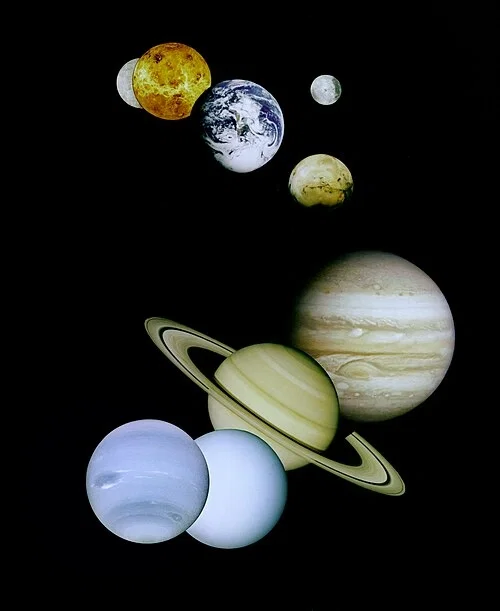
A planet is a large, rounded astronomical body that is generally required to be in orbit around a star, stellar remnant, or brown dwarf, and is not one itself. The Solar System has eight planets by the most restrictive definition of the term: the terrestrial planets Mercury, Venus, Earth, and Mars, and the giant planets Jupiter, Saturn, Uranus, and Neptune. The best available theory of planet formation is the nebular hypothesis, which posits that an interstellar cloud collapses out of a nebula to create a young protostar orbited by a protoplanetary disk. Planets grow in this disk by the gradual accumulation of material driven by gravity, a process called accretion.


