

by Planeta · Planeta · ISBN 9788489898547

VAT included




Hamelyn quality guarantee · checked and verified, or your money back
«Larousse 2000 Tomo 4» is a volume of the Larousse 2000 encyclopedia, published by Planeta in library binding, in Spanish.
This volume forms part of an encyclopedia conceived as a reference work for a wide audience. Throughout its entries, the work brings together knowledge from very different subjects and presents it clearly and accessibly, so that the reader can answer questions or find out more without needing prior knowledge.
Fourth volume of Larousse 2000, published in 1998, within an encyclopedic series of several volumes.
A useful reference work for students, researchers and anyone interested in expanding their knowledge.


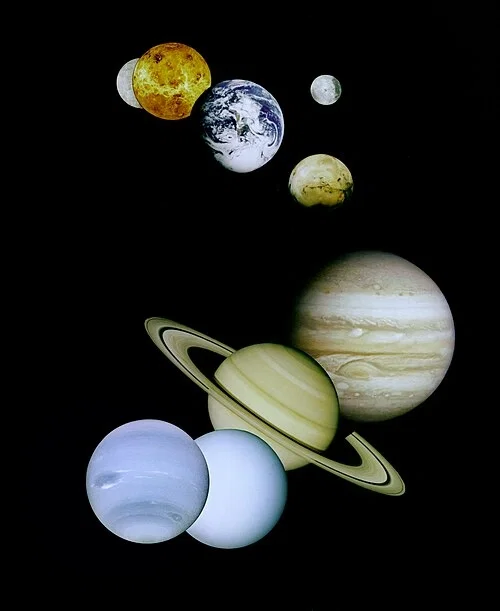
A planet is a large, rounded astronomical body that is generally required to be in orbit around a star, stellar remnant, or brown dwarf, and is not one itself. The Solar System has eight planets by the most restrictive definition of the term: the terrestrial planets Mercury, Venus, Earth, and Mars, and the giant planets Jupiter, Saturn, Uranus, and Neptune. The best available theory of planet formation is the nebular hypothesis, which posits that an interstellar cloud collapses out of a nebula to create a young protostar orbited by a protoplanetary disk. Planets grow in this disk by the gradual accumulation of material driven by gravity, a process called accretion.


